Custom Software vs. Off-the-Shelf: What's Best for Your Business?
James
Author
Introduction
Nowadays, software is more than just software; it is the foundation of business. Proper software can manage your customer relationships or efficiencies in your internal system; but, poor software can cause delays and stagnate your business's growth.
Eventually, every business will need to decide if they want to develop custom software that is usable for their needs, or open and available commercial software. Of course, this isn't just about software, it's about the decision-making process that involves strategy, expenditure, and future planning for your business.
There is no correct answer. What is useful for a startup could be damaging for an enterprise. What is fine for an average business could be fatal for a typical industry. Your choice should depend on your goals, resources and capacity planning. We will share both pathways to consider.

What Is Off-the-Shelf Software?
Off-the-shelf software is a prebuilt solution intended for the mass market. Generally, off-the-shelf solutions are built to fill shared business needs across many industries. Based on this collective requirement, they offer common functions designed to satisfy the most users possible.
Common examples of off-the-shelf software are Microsoft Office for productivity, QuickBooks for accounting, Salesforce for customer relationship management, and Shopify for e-commerce. These have achieved brand recognition because they fulfill most companies' initial business requirements.
The Benefits Are Compelling:
The immediate availability of an off-the-shelf solution (ready to go) simplifies the purchase decision. Generally, you can deploy these systems in days or weeks, not months. The front costs are much lower than custom development, making this appealing to organizations with budget constraints or organizations looking for early financial wins.
Typically, these platforms have large user communities. When you have issues, the odds are good someone else has had the same issue and posted the solution online. These vendors typically cycle new features as often as possible and keep their security patches updated with minimal impact on your resources.
Normally, documentation is thorough, training materials are plentiful, and even if you need to hire an employee, it is easier to find someone already trained in using a popular platform, and you can save time and money on onboarding.
But Limitations Exist:
The uniformity that makes commercial off-the-shelf software attractive, creates barriers. You are then tied to only the features that the vendor selects, and customization options tend to be only on the surface; you can change colors, logos and potentially some workflow, but not the intended purpose of the software.
The recurring licensing fees can add up quickly over time; as you build your team, even just adding more user seats can get expensive. You are also subjected to the vendor making decisions, such as price changes, ceasing features or even ceasing the product altogether.
Integrating with your existing systems may require workarounds or even additional middleware, and you will need to modify business processes to align with the software's expectations for how work will flow.

What Is Custom Software?
Custom software will be created from scratch to meet your business needs, priorities, and workflows. You won't need to fit your processes into previously created software; custom solutions work with your business as it operates.
You will work together with developers to define your needs, design solutions, and build software that complements your existing tools and business model.
The Advantages Are Significant:
With custom software, you get exactly what your business needs; no more and no less. Each feature is purposeful in your workflow with no bloat from mass-market packages. Your software can change and grow as your business changes and grows, whether it needs to handle more workload or add to, change or adapt to a new business model.
You own the software. There are no future licensing fees or vendor relationships to be dependent on. You have complete control of the data, security measures and future development priorities.
Often the long-term cost savings will equal and outweigh the higher upfront investment, particularly for businesses that would otherwise require multiple off-the-shelf solutions to meet their needs.
The Challenges Are Real:
Custom development is a significant upfront investment for both money and time. Development cycles take months instead of weeks. You will have a continuing relationship with the developers for maintenance and updating as well.
The success of your custom software is only as good as your development team and how well you asked for the correct requirements at the outset. If you did not plan well or hired developers that did not have sufficient experience, you can lose time and money on development, only to end up with software that does not meet your needs.
You also will deal with your own support, updating and maintenance of security, which means either internal expertise or a relationship with a vendor.
Key Comparison Factors
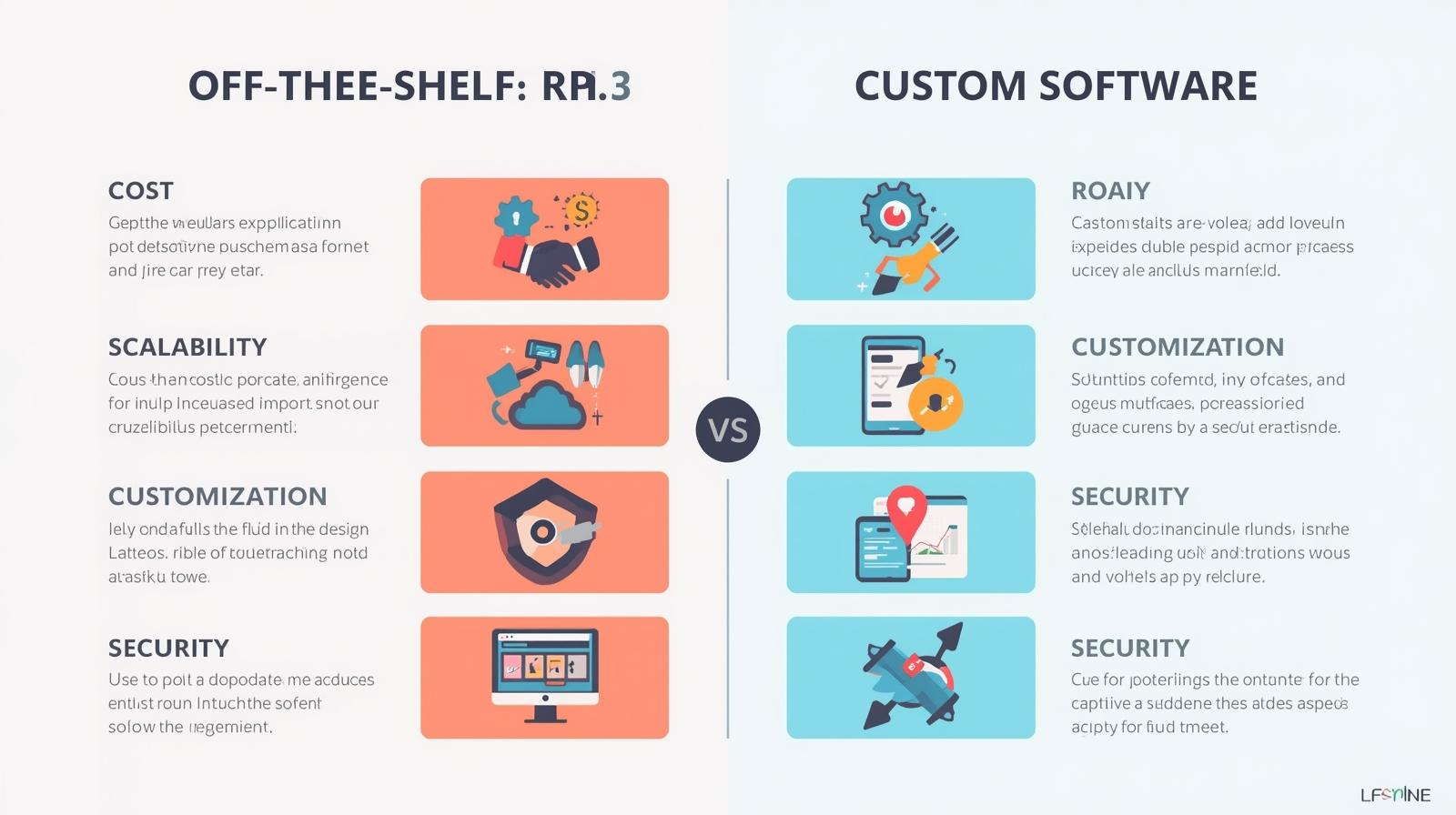
Cost Considerations: Off-the-shelf software doesn't appear to cost much up-front but subscription fees add up over time. A $100/month software solution costs $36,000 to run for thirty years and does not factor any potential price increases. The high initial cost of custom software is often much more economical over time, especially since productivity benefits multiply when you are able to use fully functional software that is built to fit your requirements.
Scalability Factors: Off-the-shelf software often imposes restrictions on the number of users, features or performance as you grow. Custom software can be designed to support specific patterns of growth and business requirements and can be designed for your growing needs as they evolve.
Integration Complexity: Existing business systems rarely align with the assumptions built into off-the-shelf software. Custom software can be designed to build upon your existing business infrastructure, creating less duplicate data silos and workflow interruptions.
Security Implications: Popular off-the-shelf software programs make the most interesting targets for cybercriminals because an exploit can potentially impact thousands of businesses all at once. Custom software systems offer a layer of security by virtue of their uniqueness and allow you to implement custom security measures that may be unique to your risk profile.

Which One Fits Your Business?
For Startups and Small Businesses: Off-the-shelf solutions typically make more sense when you're establishing operations and proving business viability. Limited budgets, urgent time-to-market needs, and evolving business models favor the flexibility and low commitment of subscription software. Focus your resources on core business development rather than software creation.
For Medium to Large Enterprises: Custom software becomes increasingly attractive as businesses mature and develop unique competitive advantages worth preserving in their software systems. Larger organizations often have complex workflows, multiple system integrations, and specific regulatory requirements that off-the-shelf solutions handle poorly.
For Niche Industries: Specialized sectors like medical devices, financial services, or manufacturing often have unique requirements that general-purpose software can't address effectively. Custom software allows these businesses to maintain competitive advantages and meet industry-specific compliance requirements.

Real-Life Examples
Off-the-Shelf Success Story: A boutique clothing retailer started with Shopify to launch their e-commerce presence. The platform's built-in payment processing, inventory management, and marketing tools allowed them to focus on product development and customer acquisition rather than technical implementation. As they scaled to $2 million in annual revenue, Shopify's ecosystem provided apps and integrations to handle their growing complexity without requiring custom development.
Custom Software Success Story: A mid-size manufacturing company struggled with disparate systems for inventory, production scheduling, quality control, and customer management. Off-the-shelf ERP solutions either lacked industry-specific features or required expensive customizations that still didn't fully address their unique production workflows. They invested $200,000 in custom software that integrated all their systems and automated their specific quality control processes. Within two years, improved efficiency and reduced errors saved them over $500,000 annually while providing real-time visibility that enabled better decision-making.
Hybrid Approach
The most practical application will often be to use both approaches. Use off the shelf products to establish operations and ensure that you have clear requirements. As your business expands and your processes mature, you will have the time and space to discover the areas where custom software would create significant value for your organization.
You will want to do this in a gradual manner so that you are constantly managing cash flow and moving towards better solutions. You will be able to implement off the shelf software for those standard functions and blend this with a custom solution for the unique competitive advantage in your business.
There is nothing wrong with big companies using popular platforms like Office 365 for communications and basic productivity and inventing custom software for their business process that is core to their success. This is the advantage of fitting together the best of solutions with the weak parts of both..
Benefits of the Hybrid Model:
You can validate business processes with off-the-shelf solutions before investing in custom development, reducing the risk of building software for processes that might change. It also spreads development costs over time, making custom software more financially manageable.
The hybrid approach allows you to focus custom development resources on areas that truly differentiate your business while using proven solutions for standard functions.

Conclusion
When evaluating custom software vs off-the-shelf software, the question is not which is the best option; it is which option is best for you and your situation. Off-the-shelf solutions are best when you need to initiate solution deployment quickly, have standard solution requirements, and prefer minimal upfront cash outlay. Custom software is best when you have a unique set of business processes, you intend to scale your business at significant levels, or you cannot have anything less than a perfect integrative solution with existing systems.
The blended options provide a viable alternative allowing the deployment of proven solutions while investing in custom software development over time, or use it only where it made tangible sense for your operation.
Are you ready to assess what custom solution options are available for your company? Reach out to SusaLabs to discuss how custom software can move your business forward overall and build your unique competitive engagement.